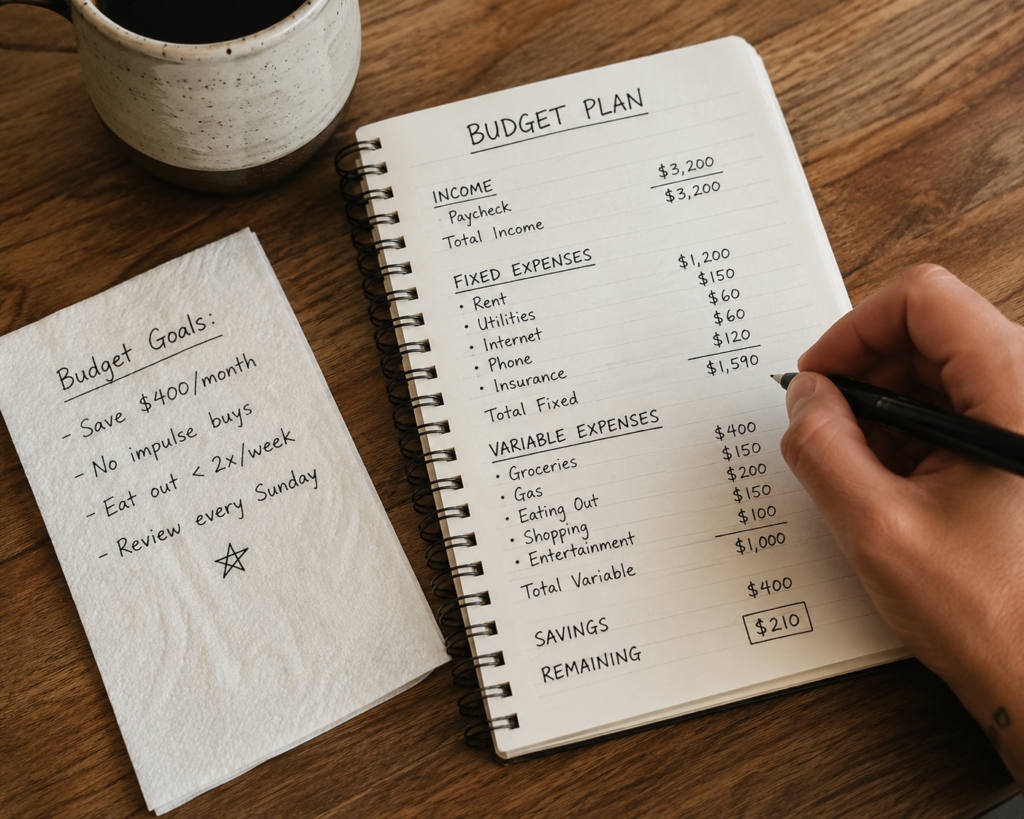
A belief is something you think. A habit is something you do. They’re related — beliefs often build the habits — but they’re not the same thing, and they don’t get fixed the same way. This post is about the habits. Not what you think about money. What you do with it, day after day, without consciously deciding.
You can rewrite a belief by examining where it came from and looking at it honestly. A habit requires something different: noticing the action, interrupting it, and replacing it with another one — long enough that the new action becomes automatic.
The five below are common enough that almost everyone who isn’t building real financial security has at least one running in the background. They don’t depend on income. There are people earning six figures who live every one of them. The fact that the income changes doesn’t mean the habits do.
Earn. Pay bills. Repeat.
This is the foundational habit, and it’s the one I grew up watching. My parents had it. My older siblings had it. The model was simple and complete: you go to work, you get paid, you pay the bills, and then you do it again. That was the whole loop. There was nothing above it. No savings. No investing. No second income line. No tracking. No conversation about money beyond we don’t have any.
This isn’t a critique of my parents — they did what they knew. The cost wasn’t that they were doing it wrong. The cost was that they passed the same model to me, and I ran it for years before I noticed there was anything else to run. The habit looks responsible. It feels responsible. But it has one fatal property: the money stops moving the second the work stops.
The replacement habit: Move one specific amount out of the loop each pay period. Not “what’s left at the end” — there’s never anything left at the end. A dollar amount, transferred automatically, before any bill gets paid. Even ten dollars. Even five. The amount matters less than building the muscle of taking something off the top before anything else gets touched.
Wait until something runs out to think about money.
Money gets thought about in households running Habit #1 almost entirely reactively. You don’t think about diapers until you’re down to two. You don’t think about the rent until the day before it’s due. You don’t think about gas until the light comes on. Each of those moments is a small emergency. And emergencies have a cost — not just emotional, but financial. You pay more for things when you’re rushing. You skip the cheaper store because you don’t have time. You make worse decisions because your nervous system is on alert.
I had a Friday night once, in my teens, sitting in a house with two days of diapers left for my baby and no plan. I knew exactly what was in the fridge. I knew exactly what was in my pocket. I could account for every dollar — because every dollar was already spoken for. That’s not a financial plan. That’s accounting under duress.
The replacement habit: Pick one fixed time per week — fifteen minutes, same day, same hour — to look at money before anything is on fire. Open the accounts. Look at what’s coming in. Look at what’s going out. The point isn’t to do anything yet. The point is to know what’s there before the moment of need.
Solve a money shortage by adding hours, not by adding skills.
When you don’t have enough, the working-class instinct is to add hours. Get a second job. Pick up overtime. Find a side gig that pays by the hour. I did this for a long stretch — three jobs at one point — and the math kept telling me it should work. Three times the hours should equal three times the money.
It didn’t. The hours added up. The exhaustion added up. The money added up too — but not in a way that ever escaped the loop. I was earning more and still treading water. What I didn’t understand for years is that hours are linear and capped. The people I watched build something durable weren’t adding hours — they were adding leverage. A skill that paid more per hour. Or something that produced money without their direct hours attached.
The replacement habit: When you feel the urge to take on more hours, ask one question first — is there a skill I could learn instead that would raise the value of the hours I already have? Sometimes the answer is still “no, I just need cash this month.” That’s a real answer. But asking the question is a habit. And asking it consistently changes what you do over a five-year stretch.
The income doesn’t fix this. The habits do.
Treat learning about money as something for “later,” or for other people.
The habit isn’t refusing to learn. The habit is just never quite getting around to it. The personal finance book on the shelf you didn’t read. The podcast you keep meaning to subscribe to. The accountant you’ll talk to “when things are a little more stable.”
For years, I had a version of this that sounded like “I’d have to go to school to learn that.” It felt responsible — like I wasn’t going to just wing it — but it functioned as a permission slip to not start. School wasn’t a real plan. It was a way to defer. The habit looks like inaction but it’s actually active avoidance. Every time you opt out of a small money decision because you “don’t know enough,” you’re reinforcing the pattern that financial knowledge belongs to other people, not you.
The replacement habit: Pick the smallest possible piece of money knowledge you don’t have right now, and learn it this week. Not a course. Not a book. A single concept. What is a Roth IRA. What’s the actual difference between a credit and a debit transaction. How does my employer’s 401(k) match work. Each one is a fifteen-minute search and a conversation. None require school. All compound.
Spend what comes in.
This is the simplest habit and the hardest to change. Money arrives. Money leaves. Whatever shows up on payday gets absorbed by the gap between what you make and what your life costs. There’s no surplus, because the spending automatically rises to meet the income. Get a raise — the spending rises too. Get a bonus — it disappears into something. The level of the lake stays exactly the same, no matter how much water you pour in.
Financial advisors call this “lifestyle creep,” but I don’t love the term. It makes it sound passive, like it just happened to you. It didn’t just happen. You made hundreds of small spending decisions that absorbed the new money. Each one felt reasonable. The aggregate was that nothing changed.
The replacement habit: When income goes up, choose in advance — before the money arrives — what percentage of the increase will not be available for spending. Move it before you see it. Even half of any raise, automatically transferred before the rest hits the spending account, breaks the pattern. The point isn’t sacrifice. The point is that the default changes from “all of it gets spent” to “some of it gets kept.”
A Note on Changing Habits
You don’t change a habit by deciding to. You change it by changing the cue that triggers it, the action you take in response, and the environment that supports the new action.
This is where the work actually happens. Not in a moment of inspiration. Not in reading an article like this one. In the small structural changes you make to your week — the automatic transfer, the calendar block for the money check-in, the one concept you commit to learning — that make the new action the easier one to take.
Pick one habit from this list. Just one. Set up the structural change that makes the replacement happen on autopilot. Then come back next month and pick another.
Income doesn’t fix money problems. Habits do. The person who earns $40,000 and runs the right habits will outrun the person who earns $80,000 and runs the wrong ones. Every time.
A note on this article: this is educational content, not personalized financial advice. Everyone’s situation is different — your income, tax bracket, family circumstances, existing debt, and retirement timeline all shape what’s right for you. Before making significant financial decisions, consider talking with a fee-only fiduciary advisor who can look at your full picture.