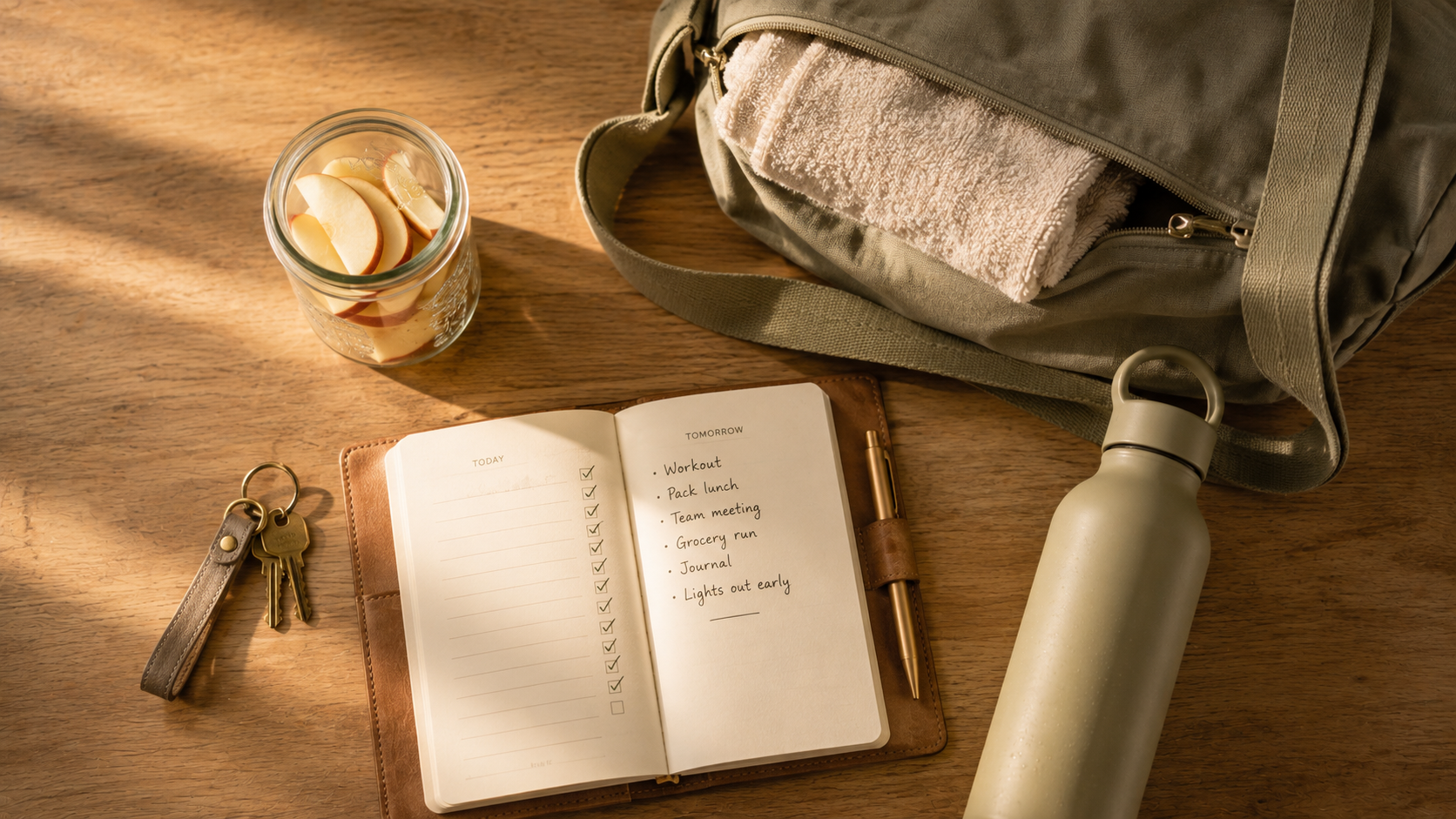
There's a gym bag on my couch right now. Packed, ready, sitting where I'll walk past it in the morning. I put it there last night — refilled the water bottle, folded a clean towel, tucked in tomorrow's clothes. Then I set it exactly where I couldn't miss it on my way out the door.
Ten years ago, none of that would have happened. I would have crashed on the couch tired, planned to work out in the morning based on how I felt, and then found some reason to skip. This wasn't because I lacked discipline. It was because I was still trying to build discipline the wrong way.
For years I believed some people just had willpower and I didn't. I put myself firmly in the second category, and every failed attempt at building better habits — the affirmations, the 5am wake-ups, the two-week bursts that collapsed — confirmed it. I was doing what I saw disciplined people do. It wasn't working.
I was wrong about all of it.
The disciplined people I know today aren't running on willpower. They're not trying harder than everyone else. They've done something more useful: they've built systems that make the right thing the easy thing. Then they've done it long enough that it stopped feeling like discipline at all.
That's the whole trick. And it's completely learnable.
What discipline actually is
Discipline isn't a personality trait. It isn't a moral quality. It isn't something you either have or don't have.
Discipline is what remains after you've removed enough friction that doing the right thing requires less energy than doing the wrong thing.
That's the working definition. Let me unpack it.
When most people try to be "more disciplined," they're really trying to muscle through resistance using willpower. They wake up early through gritted teeth. They fight the urge to eat sugar. They force themselves to the gym. This works for a stretch. Then their willpower runs out — because willpower is a finite daily resource — and they collapse back to their defaults.
Disciplined people aren't fighting the same fight and winning. They've eliminated the fight entirely. They've set up their environments, their schedules, and their choices in advance so that the default option is the right option. When they walk toward the gym, there's no willpower involved — the bag is by the door, the shoes are ready, the calendar block is protected. They just go.
The person who eats healthy isn't resisting cookies. They didn't buy cookies. There's cut fruit in the fridge, already portioned. They're not fighting anything.
The three lies about discipline
Lie #1: "I don't have willpower." Nobody has enough willpower to sustain constant fighting with themselves. The people who look like they have willpower are running systems that need very little of it.
Lie #2: "I just need to try harder." Trying harder is almost always the wrong move. What actually works is redesigning the situation so that trying isn't necessary. When you find yourself needing to try hard, that's the signal to change the environment — not to push through.
Lie #3: "I'll start Monday." This is the perfectionism trap. Waiting for the right moment, the right week, the right conditions — none of those matter. The system starts today, at whatever imperfect scale. Ten seconds of movement is a system. One serving of fruit is a system. Ten dollars in a savings account is a system.
The interior change has to come first
Here's the part I got wrong for years.
I would try to build systems for money, health, or productivity before I'd done any interior work. And every time, the systems would collapse. Not because the systems were wrong — they were fine. Because I was still operating from the same self-image, the same background belief that this wasn't for someone like me.
You cannot systematize your way out of an identity that doesn't believe in the systems. If underneath everything you still believe you're the kind of person who can't stick to things, the systems will find their way to failure. Not because they're broken. Because they're operating against a stronger current.
I wrote in another post about the transformation that happened when I stopped chanting affirmations and started listening to writers who taught me how to think differently — Haanel, Wattles, Hill, Neville Goddard. Before that shift, no system would hold. After it, systems started to hold naturally. Not because the systems changed. Because I did.
If you've tried to build discipline in the past and it didn't work, the answer might not be a better system. It might be that the interior work hasn't happened yet. Come back to this article after some of that shifts. The tools will land differently.
What discipline actually looks like — my real systems
The systems don't have to be elaborate. They just have to remove enough decision-making that you don't have to fight yourself when you're tired.
Here are some of my own. Small, mundane, but they hold.
I stopped trying to resist unhealthy snacks. Instead, I buy fruit — apples, oranges, whatever's in season — and I cut it up when I get home. One serving at a time, enough for a day or two so it doesn't spoil. Pre-portioned. When the urge to snack hits, I don't make a decision. The healthy option is already ready. The unhealthy option requires a trip to the store.
When I get home from the gym, I don't just drop the bag. I empty it, refill it with clean clothes, put a fresh towel and water bottle in it, and set it on the couch by the door. When tomorrow comes and I'm tired and my brain is looking for a reason to skip, the bag is right there. I don't have to prepare anything. The activation energy has been paid the day before.
Everything that can be on automatic draft is on automatic draft. The ones that can't — for whatever reason — I pay on the same day every month. Not "when I remember." Not "when I have time." The same calendar day. That day is now part of my monthly routine. No decision required.
Automated. Money moves before I see it. What I don't see, I don't miss. This is the same principle as everything above — the decision gets made once, at setup, and then the system runs.
None of these are impressive individually. All of them together become what looks like discipline from the outside. From the inside, it's just a series of small design decisions that made the right thing easier than the wrong thing.
The framework — designing your own systems
Any discipline system, in any area of your life, follows the same four moves.
Remove the decision
The moment you have to think about whether to do the right thing is the moment willpower gets involved. Design the situation so the decision was already made yesterday, or last month, or at setup. Automatic transfers. Pre-cut fruit. Pre-packed bag. Same-day bill payments. Whatever the domain — take the decision out of the moment.
Add a visual cue
Discipline collapses in the gap between intention and action. Visual cues close the gap. The gym bag by the door. The book on the nightstand. The savings account balance visible on your phone. Put the reminder where you'll see it before you've had time to talk yourself out of it.
Anchor to time
Habits that happen "when I have time" don't happen. Anchor the new behavior to a specific time or a specific existing habit. After I brush my teeth, I take my breaths. On the first of every month, I pay the bills that aren't on autopay. On Sunday evening, I pack tomorrow's lunch. Time and existing habits are already stable — attach the new thing to them.
Reduce activation energy
Everything requires a certain amount of energy to start. The more energy required, the less likely you are to start when you're tired. So reduce the energy. Prepare the environment the day before. Lay out the clothes. Set up the workspace. Pre-decide the workout. Whatever gets you from "should I do this" to "starting" faster is worth the small setup cost.
Discipline isn't something you have. It's something you build once — and then let run.
The mistake most people make
The people who stay stuck aren't the ones without discipline. They're the ones who keep trying to force themselves to be disciplined without changing the environment they're operating in.
You cannot willpower your way past a kitchen full of junk food. You cannot willpower your way past a phone full of distractions. You cannot willpower your way past a schedule that has no room for the thing you say matters. If the environment is set up against you, no amount of trying harder will save you.
The move is not to try harder. The move is to redesign.
If you find yourself relying on willpower to eat well, change what's in the house. If you rely on willpower to save money, automate the transfer. If you rely on willpower to go to the gym, pack the bag the night before. If you rely on willpower to write, put the notebook where you'll see it.
Every time you catch yourself using willpower, treat it as a signal — not a moral test. The signal says: the environment isn't designed yet.
When the system breaks
Systems fail sometimes. You'll skip a day. You'll break a routine. You'll notice a week has gone by without the thing you said you'd do.
This is normal. The systems weren't broken. Life happened. What matters is whether the identity survives the miss.
If missing a day makes you think "I'm not the kind of person who does this," you'll spiral back to your defaults. If missing a day makes you think "I'm the kind of person who does this, and today I didn't," you'll be back at it tomorrow.
Same event. Very different consequence.
The identity of being a disciplined person is stronger than any individual day. The system exists to support the identity — but the identity has to come first. This is why the interior work matters. Without it, every missed day is evidence you're not that person. With it, every missed day is just Tuesday.
The disciplined person isn't fighting harder. They've designed an environment that makes fighting unnecessary. The only thing to change isn't yourself. It's the situation you keep finding yourself in.
A note on this article: this is educational content based on general research and personal experience, not personalized medical, wellness, or financial advice. Everyone's body, health history, and circumstances are different. Before starting a new physical practice, changing your diet, or making significant financial decisions, consider talking with an appropriate professional.