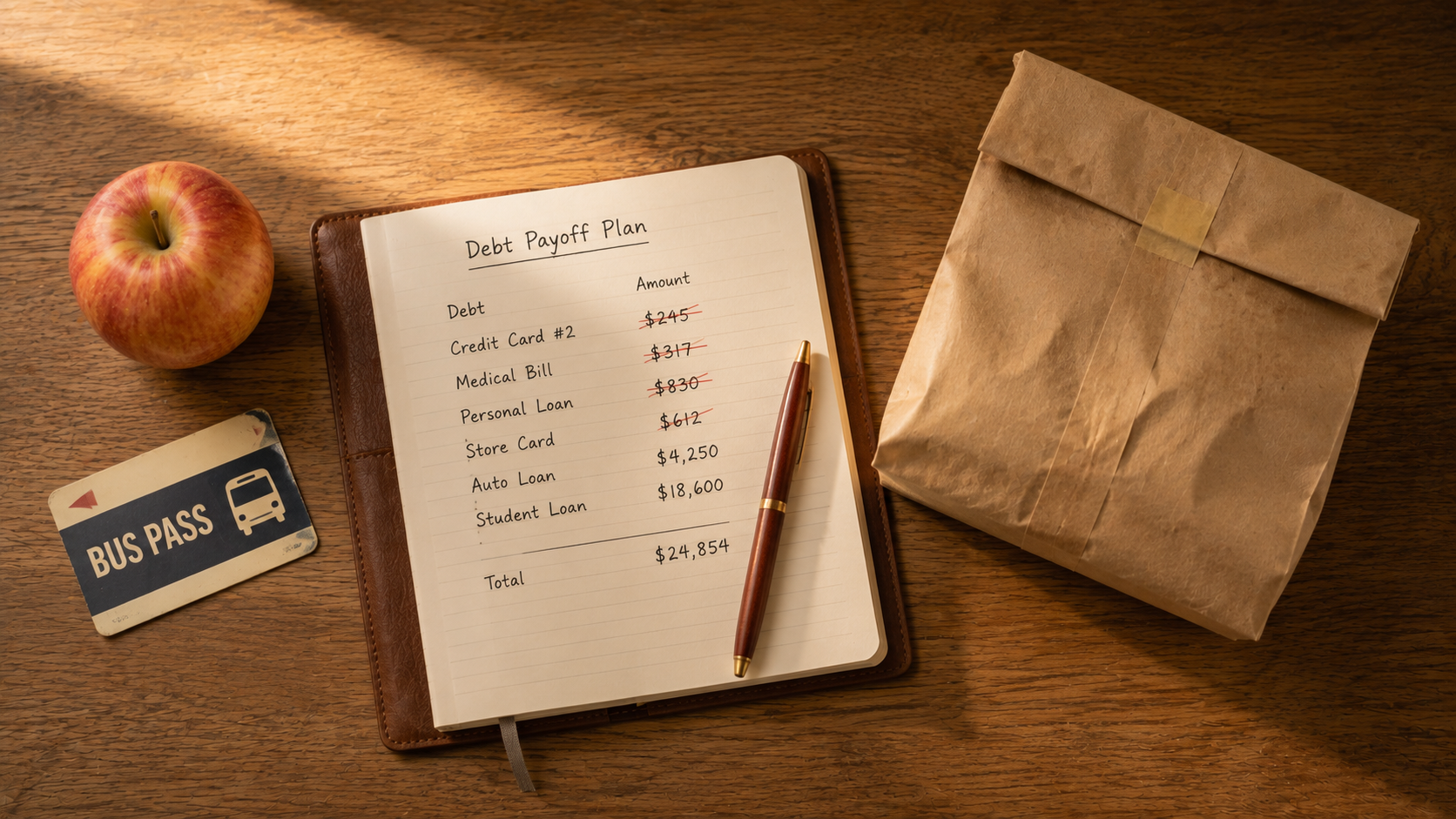
I can still remember getting off the bus at my stop on the way to work. The exact block. The exact morning. The specific feeling in my body. Everything else was already paid off. The car was the last debt. That check was going in later that day, and by the time I walked back to that same bus stop after work, I would be — for the first time in years — completely debt free.
I felt a kind of quiet pride I hadn't experienced in a long time. Not the loud kind. The private kind. Nobody at work knew what that morning meant.
To understand why it meant so much, I have to go back further.
The rulebook I inherited
I never used credit until I was in my late twenties. Not once. My family didn't have money, but we had a philosophy: if you have cash, you can buy it; if you don't, you wait, or it wasn't for you. That was the rulebook.
My parents used layaway when I was a kid — a system where you'd pick out what you wanted at a store, pay a small deposit, and continue making payments over weeks or months until it was paid off. Then the store gave it to you. No interest. No debt. Just a plan to pay in cash over time. It was a version of financial discipline the world doesn't offer anymore. I remember when layaway disappeared. I think about it sometimes when I see young people signing up for buy-now-pay-later apps that carry all the risk of credit with none of the safety of the old system.
My mother would take us to New York City's garment district a few times a year to buy our clothes. Not one shirt or one pair of pants — a dozen shirts, a dozen pairs of pants, plus outerwear for the changing seasons. In cash, from the small manufacturers who sold direct. That's how a working-class family in that era dressed six kids on the money coming in.
I got married straight out of high school. I didn't shop in bulk the way my mother had, but I paid cash for everything. Furniture, groceries, small treats for the kids. If we didn't have the money, we didn't buy it. The system held for years.
Navy years — the cash system worked
I joined the Navy and got stationed in San Diego. My family stayed on the East Coast for about a year and a half while I got settled and saved for what we'd need. Once I had enough cash to furnish an apartment, I moved them out to join me.
A bed for my wife and me. A bunk bed and a small bed for the three kids sharing one room. A couch. A small TV. Then, once they arrived, dishes and pots and pans. All cash. All bought over a couple of months.
It worked so well that our extended family started following us out to California. Both sides. Cousins, siblings, a few of the older relatives — they came because we'd made it look possible and they wanted the same thing. I helped them find apartments in the same complex. Suddenly we weren't homesick anymore. We were living the version of adulthood I'd hoped for.
We didn't have a car. I took the bus from home to base every day. Everyone had one bike, one bus route, one rhythm. It was enough.
The deployment mistake
Then I got orders for an overseas tour. Minimum six months. My wife and I had a conversation before I left, and we made a plan.
We agreed that we could get some new furniture around the apartment, and I would buy a car so she could drive during the long days I'd be gone. But we would stick to the bigger plan — she would go to school, I would go after the Navy was over.
A neighbor knew someone down the street selling a car. A small Honda hatchback. Manual transmission — stick shift. My wife didn't love the idea, but I reminded her that her brother back in New York drove one, and she could learn.
I admit, I didn't know how to drive stick either. I was deploying in a couple of days. I started to learn during the little time I had. Got the concept, more or less. I wasn't fluent when I left.
Here's the part I still think about sometimes.
I gave her access to our main checking account for regular monthly bills. Fine. Necessary.
I gave her access to a second account with the money set aside for the furniture. Bad decision in hindsight, but I could see the logic.
Then I did something I still don't fully understand. I gave her access to our third account — the savings I'd been building for post-Navy life. The money that was going to carry us through the months between when I got out and when I found civilian work.
Remember: she didn't want me to re-enlist. She wanted me out. So I was building a runway for us both.
I left. Six months went by.
Coming home
I flew home. She'd been strangely quiet in her letters — nothing specific about the apartment, the car, the money. I chalked it up to just missing me.
When I walked in, the apartment was the same. Nothing new. No new furniture. Nothing rearranged. Same everything.
Her explanations didn't make sense.
I looked at the accounts. Each one had five dollars in it — the minimum required to keep the account open. Everything else was gone.
The car was still parked in the same spot I'd left it in. She'd never driven it. She hadn't wanted to learn stick.
I remember trying to make sense of what had happened, and not being able to. The money was gone. The furniture was never bought. The car was never driven. And I still had almost a year of active duty left — and now I had to figure out how to rebuild everything I'd already built once, from a smaller base than before.
First time in credit
For the first time in my life, I had to take out credit.
I needed furniture — the same items I'd bought in cash the first time. I needed a car she could actually drive — an automatic transmission. And I had less than a year to build back a runway for post-Navy life.
There wasn't time to save. There wasn't cash on hand. There were only credit cards, financing offers, and the sinking feeling that I was doing something I'd told myself I would never do.
I rearranged my accounts to cover new bills. Bills I never should have had.
When the marriage ended
You already know part of this from another post. The short version: things fell apart. She didn't want to go to school after all. She eventually took a job but wouldn't contribute her income toward the bills. The marriage ended.
I left the Navy without a job lined up. I had a couple of months of payments saved — a small cushion — but nothing close to enough for what I was carrying.
I lost the apartment. My older brother, who had by then moved into the same apartment complex, agreed to take the furniture and continue making the payments. That lasted about a month before the late notices started arriving. I should have known. He was the same brother I grew up with, from the same family that had never known how to handle money. I don't blame him. I do blame myself for hoping the pattern would somehow be different this time.
I kept the car. It was my transportation, and for a little while, it was also my housing.
I got a credit card — the first and only time I ever leaned on one for basic needs. It helped me eat. It helped me make payments. It kept me moving.
The San Diego job
Then the City of San Diego responded to one of my applications, and I got a job.
I remember the feeling exactly. A quiet, deep gratitude I hadn't felt in a long time. It took a few pay dates to save enough to get into a studio apartment, but I did. I went to a thrift store and bought what I needed — a small table, a chair, a few kitchen items.
Life was looking better. But I was still deep in debt. I was still paying for furniture I wasn't using, in an apartment complex I no longer lived in, on behalf of a brother who was late with every payment.
The night I sat down with a pen
For the first time in my life, I sat down and wrote out every debt I had.
I had never had to do that before. I had never had debt before.
I listed everything. Amounts owed. Minimum payments. Interest rates where I could find them.
Then I looked at the list and made a decision that I now know has a name.
I decided to attack the smallest debt first. Not the highest interest rate. The smallest balance. The one I could kill fastest.
I threw everything I could at it — every extra dollar I could scrape together. Once it was gone, I took the amount I'd been paying on it and rolled it into the next smallest debt. Then the next. Each debt fell faster than the one before it, because the payment I was making got bigger every time one dropped off.
I found out much later that this is called the Snowball Method. Dave Ramsey popularized it. There's a competing strategy called the Avalanche Method that has you attack the highest interest rate first — mathematically better, but psychologically harder because you don't feel the wins as often.
I didn't know any of that at the time. I just did what felt right. Small wins first. Momentum matters more than math when you're the one carrying the weight.
Snowball Method. Attack the smallest balance first, regardless of interest rate. Faster psychological wins. Better momentum. This is what I used before I knew it had a name.
Avalanche Method. Attack the highest interest rate first. Mathematically saves more money over time. Requires more patience because the first debt might take a long time to kill.
Both work. The one that works best for you is the one you'll actually stick with. If you need to feel progress to keep going, use Snowball. If you're a numbers person who stays motivated by the math, use Avalanche. Don't overthink the choice. Just start.
How each strategy would tackle the exact same situation
Imagine someone has four debts totaling $11,700. Here's the order each strategy would pay them off:
| Debt | Balance | Interest | Snowball | Avalanche |
|---|---|---|---|---|
| Credit Card A | $500 | 22% | 1st | 1st |
| Medical Bill | $1,200 | 0% | 2nd | 4th |
| Credit Card B | $2,000 | 18% | 3rd | 2nd |
| Car Loan | $8,000 | 6% | 4th | 3rd |
Snowball sorts by balance size — smallest first — giving you a quick win with the $500 card, then another quick win with the $1,200 medical bill. Two victories inside a few months. That momentum matters.
Avalanche sorts by interest rate — highest first — attacking the 22% card, then the 18% card, then the car loan. It leaves the 0% medical bill for last because it's not costing anything extra to wait. Mathematically, this saves more money in total interest paid.
Notice the top-priority debt (Credit Card A at 22% interest and $500 balance) is the same for both methods — because it happens to be both the smallest and the highest-rate. The strategies only diverge after that.
The sacrifices
The strategy alone wasn't enough. I had to change how I lived.
I took the bus to work instead of driving. Cheaper. Slower. Sometimes uncomfortable in bad weather. But it saved me money I could put toward debt.
I packed a lunch every single day. Never ate out. Ever. Not once for months.
I didn't have a social life. Not for a while. I couldn't afford one, and honestly, I didn't have the energy for one. The work of digging out took everything I had.
These sacrifices felt hard when they were happening. Looking back, they were the least of what I'd already been through, and they had a clear endpoint. I could see the finish line.
The debt strategy isn't the hard part. Becoming the person who can execute it — that's the hard part.
The bus stop
Which brings me back to the morning I started this article with.
I got off the bus at my stop on the way to work. Everything else was paid off. The car was going to be paid off later that day. I remember the specific feeling — pride, but the quiet kind. The private kind.
Nobody at work knew what that morning meant.
I had climbed out of a hole I never should have been in. I had done it alone. I had used a strategy nobody taught me, that I later found out had a name. And I had done it while learning who I actually was — someone capable of building, losing everything, and building again.
What I learned
After that, I went back to my old ways. Cash for everything. If I had it, I bought it. If not, I waited or decided it wasn't for me.
It was a long time before I used credit again — years. And when I finally did, it wasn't for furniture or a car or anything I could have delayed. It was for full-time school. An investment in myself. A different kind of debt, taken on with a different mindset, for a different purpose.
The lesson from all of it: debt itself isn't the enemy. Debt for consumption almost always is. Debt for investment in something that will pay you back — an education, a business, a home you actually intend to keep for decades — is a tool. The trick is knowing which is which, and being honest with yourself about the distinction.
The debt strategy isn't the hard part. Becoming the person who can execute it — that's the hard part. Writing down what you owe and picking a method takes an afternoon. Building the person who can sit on the bus for months, pack the lunch, and stay steady when it feels like the payoff will never come — that's the work. Once that person exists, they can carry you through anything.
A note on this article: this is educational content, not personalized financial advice. Everyone's situation is different — your income, existing debt, family circumstances, and interest rates all shape what's right for you. Before making significant financial decisions, consider talking with a fee-only fiduciary advisor who can look at your full picture.